- Role
- Team member 2023; Avionics Team Lead 2024
- Timeframe
- 2023–2024
Bluestone is a custom flight computer built for advanced, spaceshot-capable high-powered rockets, intended to serve as the primary avionics system for UC Aerospace’s future spaceshot missions. I worked on it in two different capacities: as a team member in 2023, responsible for the sensing hardware, and as Avionics Team Lead in 2024, responsible for the direction of the second hardware revision.
In 2023 I led the design and selection of the sensor suite, identifying and integrating the components the flight would be measured with: high-G accelerometers, magnetometers, barometric sensors, temperature and humidity sensors, and a thermocouple ADC interface over I2C. I then designed and laid out the Sensor Board schematic and PCB, applying layout practices that minimise trace length so communication between the sensors and the RP2040 stayed reliable.
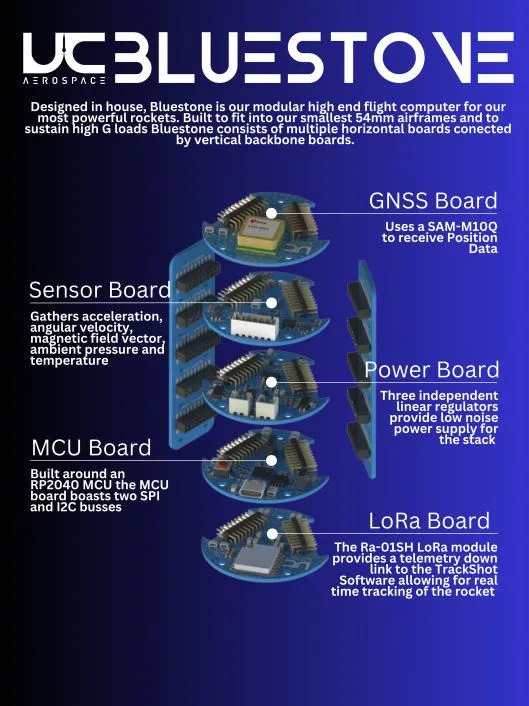
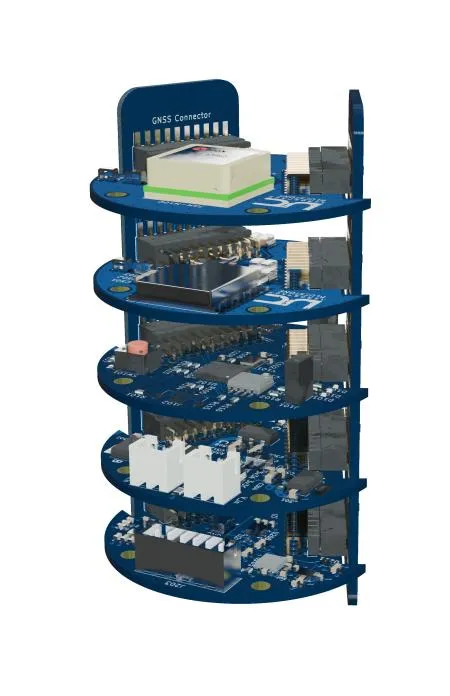
After taking over as Avionics Team Lead in 2024, I directed the design of the second hardware revision, which was aimed at the major issues the first prototype had exposed. That meant resolving MCU USB interface faults, upgrading to USB-C connectivity, and redesigning the power stage around high-efficiency switching regulators to mitigate thermal issues.
The project also included the development of a FreeRTOS-based real-time operating system in C. It was subsequently handed over to other developers for completion rather than finished under my direction.
Technologies
Key outcomes
Achieved reliable tracking and telemetry during lower-powered test flights up to 8,000 feet, demonstrating strong potential for high-altitude and future spaceshot applications.